

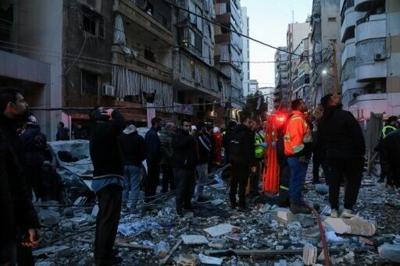
When an air strike hit their Beirut neighbourhood, people were angry with Israel, but they reserved their deepest rage for Hezbollah, for dragging Lebanon into the Middle East war.
Israel and the United States launched huge strikes on Iran on February 28, killing its supreme leader and sparking a massive retaliatory campaign.
Iran-backed Hezbollah, already weakened by war, attacked Israel in support of its sponsors, pulling Lebanon into a new cycle of strikes, death and mass displacement.
"Hezbollah must surrender its weapons to the state, period," Randa Harb, an elderly woman who runs a fruit and vegetable stall in the neighbourhood of Aisha Bakkar, told AFP.
The densely populated area was struck on Wednesday morning, wounding four people according to the health ministry, and sparking shock across the capital.
Another woman, who refused to give her name, told AFP a relative was wounded, and she accused Hezbollah of forcing "one war too many" on the Lebanese.
- 'Killing each other' -
Lebanon was torn apart by a civil war that ended in 1990, with only Hezbollah refusing to hand over its weapons to the state when peace returned.
For decades, it was believed to have an arsenal more powerful than the military's, and it fought multiple wars with Israel that each took a devastating toll.
The most recent hostilities should have ended in a ceasefire in 2024, but that too proved fragile, with Israel keeping up its strikes even as the Lebanese military sought to disarm Hezbollah under the terms of the truce.
Inspecting the damage in her cousin's apartment, 46-year-old Amal Hisham screamed: "I do not care about Hezbollah!"
The windows were shattered, and the gold-coloured sofas left in tatters.
Hisham was also enraged with Israel, saying she couldn't just blame one side. "They are all just killing each other," she said.
"Do you think they are happy about their areas being destroyed? They're not happy. Their families have been displaced," she said, referring to Hezbollah members and their wider support base.
"Who will compensate these people?"
- 'Pointless battles' -
As soon as the injured had been evacuated, residents began to wonder who the target had been.
A shop owner, also requesting anonymity, believed Hezbollah operatives were hiding there, while others imagined it was Hamas, the group's Palestinian ally.
"No matter," said Mohammed Ahmed, 42. "The presence of Hezbollah or Hamas poses a great danger to us."
"If one wants to be martyred, let him stay where he is... let him be martyred alone, why come to people who are already tired?"


Lebanon is deeply divided along sectarian lines, with Hezbollah rooted in the Shia Muslim community, that was long sidelined by authorities.
Aisha Bakkar is one of several Beirut neighbourhoods that are majority Sunni Muslim, while Lebanon is also home to Christians, Druze and others.
- 'They shot my son' -
Aziza, who sheltered families fleeing the 2024 war, worries about the massive influx of displaced people from Beirut's southern suburbs, where Hezbollah holds sway, and which have come under Israeli bombardment.
"We came to welcome them... they shot my son in the leg" after he complained that they had raised Hezbollah's flag, she said.
In majority-Christian Mar Mikhael on the other side of Beirut, a 68-year-old grocery store owner also deplored the group's decision to enter the war.
"Hezbollah makes decisions without concerning itself with the country or even its support base, it is waging pointless battles... what good will it do? You fire a missile, they fire a hundred back at you," he said.
Hezbollah was at the height of its popularity following the 2006 war with Israel, which it claimed to have won.
That changed.
"We never hated the Sayyed," said Ghada, a municipal worker, referring to late Hezbollah leader Hassan Nasrallah who was killed by Israel in 2024.
"He is the one who stopped Israel," she said.
Bolstering the belief that Hezbollah was operating solely as an Iranian proxy, the Iranian Revolutionary Guard Corps announced that Hezbollah had "officially entered the war" around three hours before the Lebanese group had issued its own statement.
Some Lebanese Shia have also grown impatient.
"No one wanted this war," Lina Hamdan, a Shia lawyer, told AFP, adding that her community "are the first victims".
A longtime critic, she believes this war may be a "turning point" for Hezbollah, whose military activities were outlawed by the government last week.
While many displaced stranded in the capital refrained from criticising Hezbollah, some voiced frustration.
"What was the point of this war? Nothing about this makes sense," said Hiam, a 53-year-old mother sheltering in a school.
Hezbollah runs schools and hospitals, and long provided Shia Lebanese with assistance.
"This time, we are left to fend for ourselves," Hiam added.
cl/nad/ser



Commented
Sorry, there are no recent results for popular commented articles.